
Realistic Cost-Per-Lead (CPL) Ranges for Local Services
Realistic Cost-Per-Lead (CPL) Ranges for Local Service Reels (Lead Form)
If you’ve ever launched a Facebook or Instagram Reel ad for a local service business and thought, “Why is this lead so expensive?” you’re not alone.
One of the biggest mistakes local businesses make is judging a campaign too quickly without knowing what a normal cost-per-lead actually looks like—especially in small-to-mid markets.
This article breaks down realistic CPL ranges you can expect when running Reels ads that send people into a Lead Form, plus what to do when your results fall into the “bad” zone.
What Is CPL (Cost Per Lead)?
CPL (Cost Per Lead) is the amount of money you spend in ads to generate one lead.
Example:
If you spend $300 and receive 10 leads, your CPL is $30.
CPL matters because it tells you whether your marketing is scalable. If you can buy leads profitably, you can grow predictably.
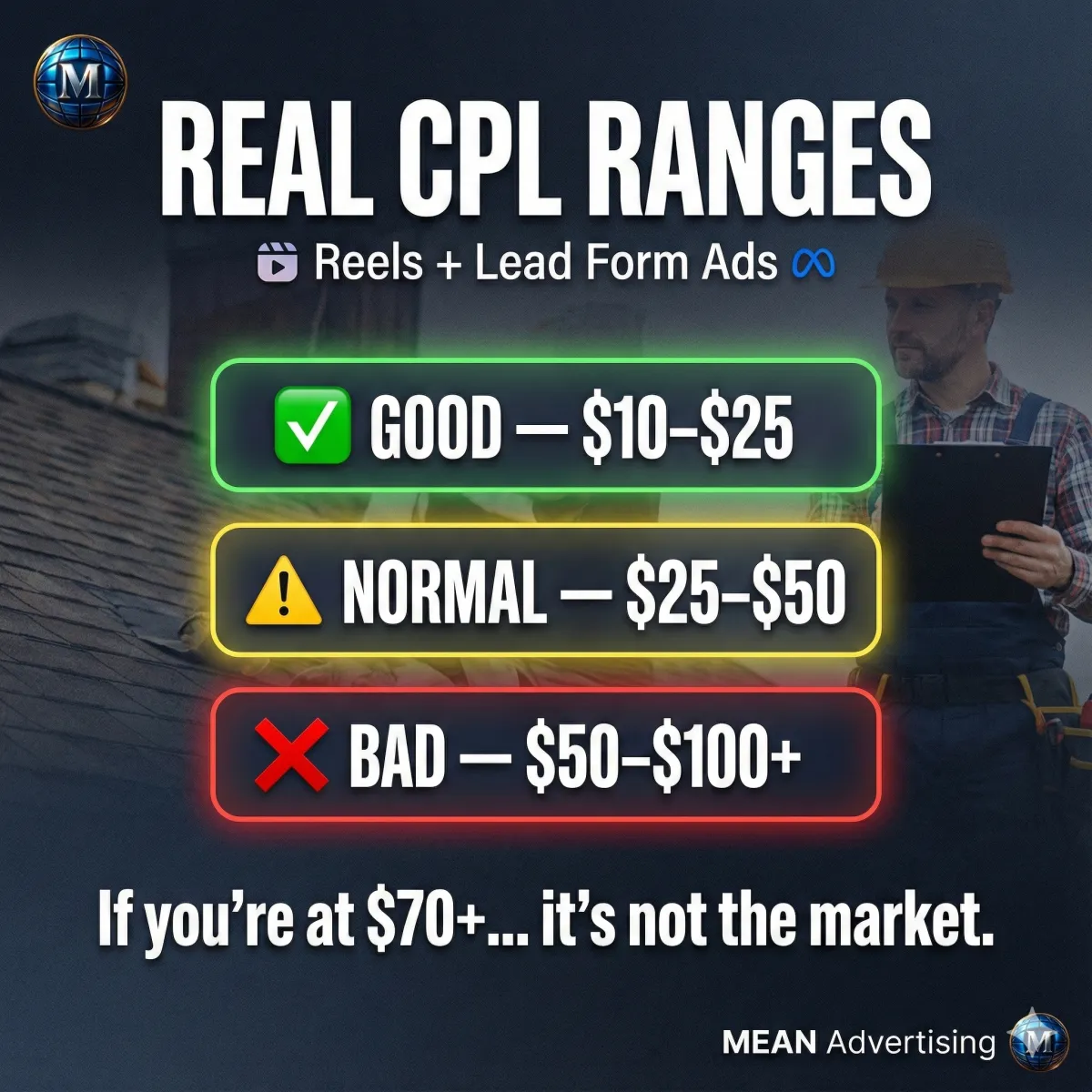
Realistic CPL Ranges for Local Home Service Reels (Lead Form)
When you run Reels ads with a Lead Form for home services (roofing, plumbing, HVAC, gutters, remodels, etc.), these are realistic ranges for most small-to-mid markets:
Good CPL: $10–$25 Per Lead
This is the ideal range.
If you’re getting leads for $10–$25, it usually means:
Your Reel hook is strong
Your offer is clear
Your Lead Form is simple
Your targeting is solid
If you’re consistently in this range, you can often scale without breaking the system.
Normal CPL: $25–$50 Per Lead
This is very common—and still workable for most service businesses.
Many campaigns start in this range before optimization.
If you’re at $25–$50 per lead, it usually means:
Your ad is performing “fine”
Your offer is okay but not sharp
Your creative could be stronger
Your follow-up process may need improvement
This is the range where small tweaks can make a big difference.
Bad / Unoptimized CPL: $50–$100+ Per Lead
This range is a warning sign.
If you’re paying $50–$100+ per lead, the campaign usually has one or more of these problems:
The Reel doesn’t stop the scroll
The message is too generic
The offer doesn’t feel urgent
The Lead Form asks too many questions
Targeting is too broad
Follow-up is slow or inconsistent
The good news: this range is often fixable quickly.
Why Tree Service CPL Can Be Higher (But Still Worth It)
Tree service can skew slightly higher than other trades, especially when competition is heavy.
Reasons tree service CPL is often higher:
Many companies are bidding on the same homeowners
The market can be saturated
People often “price shop” more
However, tree service has one major advantage:
Urgency Helps Conversion
Storm damage, safety risks, and fallen limbs create urgency. That urgency often increases conversion rates and lead quality—even if CPL runs slightly higher.
For tree service, don’t only look at CPL. Ask:
Are leads booking fast?
Are they converting into real jobs?
Are you contacting them immediately?
The Truth About CPL: Low CPL Doesn’t Always Mean Profit
A “good” CPL doesn’t matter if you don’t have a system to convert leads into paying jobs.
You can pay $15 per lead and still lose money if:
Nobody answers the phone
Nobody texts back quickly
Leads sit in a spreadsheet
There’s no pipeline process
There’s no automation or follow-up sequence
And you can pay $50 per lead and still win big if:
Your close rate is strong
Your average job size is high
Your follow-up is instant
You have a real lead management system
CPL is only one piece. The real profit happens when leads are managed correctly.
How to Lower CPL for Local Service Reels (Without Guessing)
If your CPL is too high, don’t panic. Fix the parts that actually drive cost.
Improve the Hook (0–3 Seconds)
If your Reel doesn’t interrupt the scroll immediately, CPL climbs fast.
A strong hook usually includes:
Movement on camera
Bold on-screen text
A direct callout (“Are you a homeowner in ___?”)
A clear promise (“Here’s how to fix ___ fast.”)
Strengthen the Offer
Instead of vague offers like “Free Quote,” use something that feels urgent and valuable, such as:
Same-week availability
Storm damage inspections
Safety checks
“I handle the insurance paperwork”
A specific outcome (“Get this fixed before it becomes a bigger problem”)
The offer should feel like a no-brainer.
Simplify the Lead Form
The longer the Lead Form, the more people drop off.
A strong Lead Form usually only needs:
Name
Phone number
Zip code
One qualifying question
Every extra question usually increases CPL.
Add Instant Follow-Up Automation
This is the hidden multiplier.
When leads are contacted immediately:
Conversion rates go up
Ad platforms learn faster
Costs often go down
Even the best ad will “feel expensive” if follow-up is slow.
Quick CPL Summary: What Your Results Actually Mean
Use this as your baseline:
$10–$25 per lead = Good (scale it)
$25–$50 per lead = Normal (optimize it)
$50–$100+ per lead = Bad (fix hook, offer, form, follow-up)
CPL is not something to guess about—it’s a diagnostic tool.
If you’re paying too much per lead, it usually isn’t “the market.” It’s one of the controllable variables.
Final Takeaway: CPL Should Predict Profit, Not Stress
The goal isn’t just cheap leads.
The goal is consistent leads that convert into revenue.
If you want help benchmarking your CPL for your specific service and market—and tightening the hook, offer, form, and follow-up—I built the MEAN Advertising System for exactly that.